Motor Power Ratings Explained: What 500W and 750W Actually Mean
500W might be plenty for your commute and how “peak power” marketing often hides the truth.
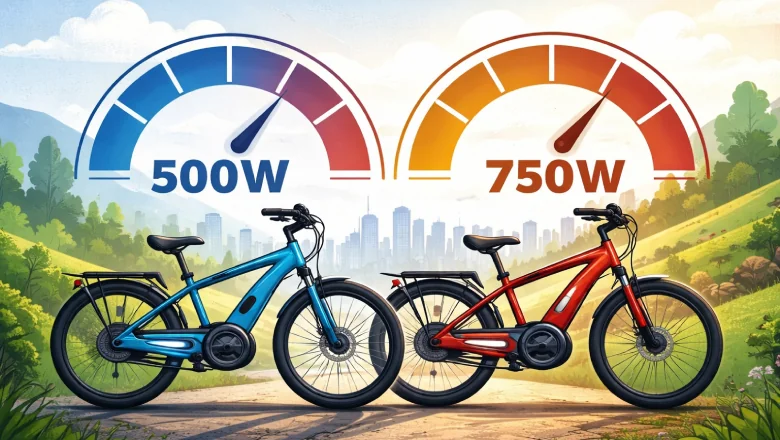
When shopping for an e-bike, motor power is often the first spec people notice. Listings highlight numbers like 500 watts or 750 watts, and it is easy to assume that higher automatically means better.
For commuting and everyday transportation, that assumption can be misleading. Motor power matters, but not in the way it is usually presented. This article explains what those watt numbers actually represent, how they affect real world use, and when more power makes a meaningful difference. Everything here is based on manufacturer specifications and how these systems are designed to be used, not on hands on riding.
Why Motor Power Gets So Much Attention
Power numbers are simple to compare. A larger number feels like a safer choice, especially for people worried about hills, speed, or keeping up with traffic.
Manufacturers also emphasize wattage because it is easy to market. A single number looks objective, even though it only describes one part of a much larger system.
For daily commuting, the better question is not how powerful the motor is in isolation. The better question is how that power is delivered and what problem it is meant to solve.
What a Watt Actually Measures
A watt is a unit of power. In simple terms, it describes how much energy the motor can use over time.
On an e-bike, the watt rating usually refers to the motor’s continuous rated power. This is the amount of power the motor can deliver steadily without overheating or causing damage. Some listings also mention peak power, which is a higher number the motor can reach briefly during acceleration or climbing.
This distinction matters because two motors with the same listed wattage can behave very differently depending on how they are tuned and supported by the battery and controller.
The Difference Between 500W and 750W on Paper
A 750 watt motor can draw more power than a 500 watt motor. In theory, this allows for stronger acceleration and better performance under load.
However, that extra power only shows up in certain situations. These include starting from a stop, climbing steep hills, or carrying heavy cargo. At steady cruising speeds, both motors often operate well below their maximum output.
For many commutes, the motor spends most of its time delivering far less than its rated power.
How Motor Power Affects Speed
Motor power does not directly determine top speed. Speed is usually limited by software, local regulations, and gearing.
In many regions, e-bikes are capped at specific assist speeds. Once that limit is reached, adding more motor power does not make the bike go faster. It simply means the motor reaches that speed with less strain.
For commuting, this means a 750 watt motor will not necessarily get you to work faster than a 500 watt motor if both are speed limited in the same way.
Hills, Weight, and Load
This is where power differences matter most.
Heavier riders, long hills, frequent stops on inclines, and added cargo all increase the demand on the motor. In these cases, a higher watt motor can maintain assist more comfortably without drawing excessive current or slowing down.
A 500 watt motor can handle many hills, especially on moderate routes. A 750 watt motor provides more headroom. That headroom can feel reassuring, but it is only necessary if your route consistently demands it.
If your commute is mostly flat with short or gentle hills, the practical difference may be small.
Power, Battery Use, and Range
More power also means the potential to use more energy. A higher watt motor can drain a battery faster if it is used aggressively.
This does not mean higher power automatically reduces range. It means the rider has more available output, and how that output is used matters.
On a flat commute at moderate assist, a 750 watt motor may use no more energy than a 500 watt motor. On a hilly route with frequent acceleration, the difference becomes more noticeable.
For transportation, range depends more on battery size and assist level than on motor wattage alone.
The Role of the Controller and Tuning
Motor ratings do not tell the full story. The controller determines how smoothly power is delivered and how aggressively the motor responds.
Two e-bikes with the same watt rating can feel very different depending on software tuning. One may deliver power gradually and predictably. Another may feel more abrupt or eager.
This is one reason wattage alone is a poor comparison tool. It does not describe how the bike behaves in traffic or how easy it is to manage at low speeds.
Legal and Practical Limits
In many places, higher watt motors are associated with stricter classifications or different rules. Even when legal, higher power can draw more attention and may feel unnecessary for routine trips.
For commuting, staying within common classifications often simplifies ownership. It reduces uncertainty about where you can ride and how the bike is perceived.
Choosing the highest watt number available is not always the most practical choice.
What Often Matters More Than Wattage
For daily commuting, motor wattage is only one part of a much larger system. Other factors often have a greater impact on how useful and reliable an e-bike feels in everyday use.
Battery capacity determines how far you can ride before recharging. A larger battery can provide more consistent assistance over longer trips, regardless of motor power.
Motor placement affects efficiency, maintenance needs, and how power is delivered. These differences can influence long term ownership more than peak output numbers.
Overall bike weight matters when carrying the e-bike up stairs, lifting it onto racks, or storing it in small spaces. A lighter bike can be easier to live with, even if it has a lower power rating.
Assist tuning plays a major role in comfort and control. Smooth and predictable power delivery often matters more than how much power is available in short bursts.
Taken together, these factors usually shape the commuting experience more than wattage alone.
A Practical Way to Think About Motor Power
A 500 watt motor is generally sufficient for flat to moderately hilly commutes with normal rider weight and light cargo. It supports steady assist, predictable behavior, and good efficiency.
A 750 watt motor makes more sense for heavier riders, frequent hills, or situations where extra load is common. It provides margin rather than speed.
Neither option is inherently better. Each is suited to different demands.
Motor wattage is a capacity number, not a promise of speed or performance. It tells you how much work the motor can handle, not how the e-bike will behave in daily use.
For commuting, the right motor power is the one that matches your route, weight, and expectations without adding unnecessary complexity or cost. Once those needs are met, higher numbers offer diminishing returns.
Understanding this helps shift the decision away from marketing and toward practical transportation.